
By Vlack
February opens with a magnificent lineup in the evening twilight: Saturn, almost-New Moon, and shining Venus. This tableau of two planets and Moon, slightly reshuffled, will repeat on February 2. Look to the western sky just after sunset (7:30 pm).
On the nights of February 6 & 7, the waxing Moon will pass near the planet Jupiter, which is in the northern sky outshining all stars, including nearby bright star Aldebaran in the V-shaped Hyades constellation.
The alpha-Centaurid meteor shower can be seen between January 28 and February 21, falling from the southern sky near the Pointers. These meteors are renowned for their blue or yellow fireballs, with trains that can last for minutes. The peak rate, about 6 falls per hour, will occur on February 8. However, the Moon, approaching fullness at this time, may be
a nuisance for observers.
On February 9, the Moon can be seen to pass near yet another planet in the northern night sky- Mars, which will be in Gemini, and close to the Twin stars, Castor and Pollux.
Venus has been drawing closer to the Earth, and, being an inner planet, showing us phases and more of its dark side, but still getting steadily brighter- until February 15,after which it will fade and become lost to sight passing in front of the Sun.
Venus has often been thought of as Earth’s sister planet, and eons ago they may have had comparable environments. But thanks to a runaway greenhouse effect, Venus’s surface is now hotter than even Mercury’s, about 460°C, with a thick, acidic atmosphere. There are other peculiarities: Venus’s day (243 Earth days) is longer than its year (224 days); and, spinning counter to most of the other solar planets, Venus has the Sun rising in the west. Despite these eccentricities, humans persist in sending rockets to Venus; as this goes to press, Rocket Lab is launching the Venus Life Finder mission to search for complex organic chemistry, and perhaps even life in some form, within the high-reaching clouds of Venus (which are much cooler than the surface).
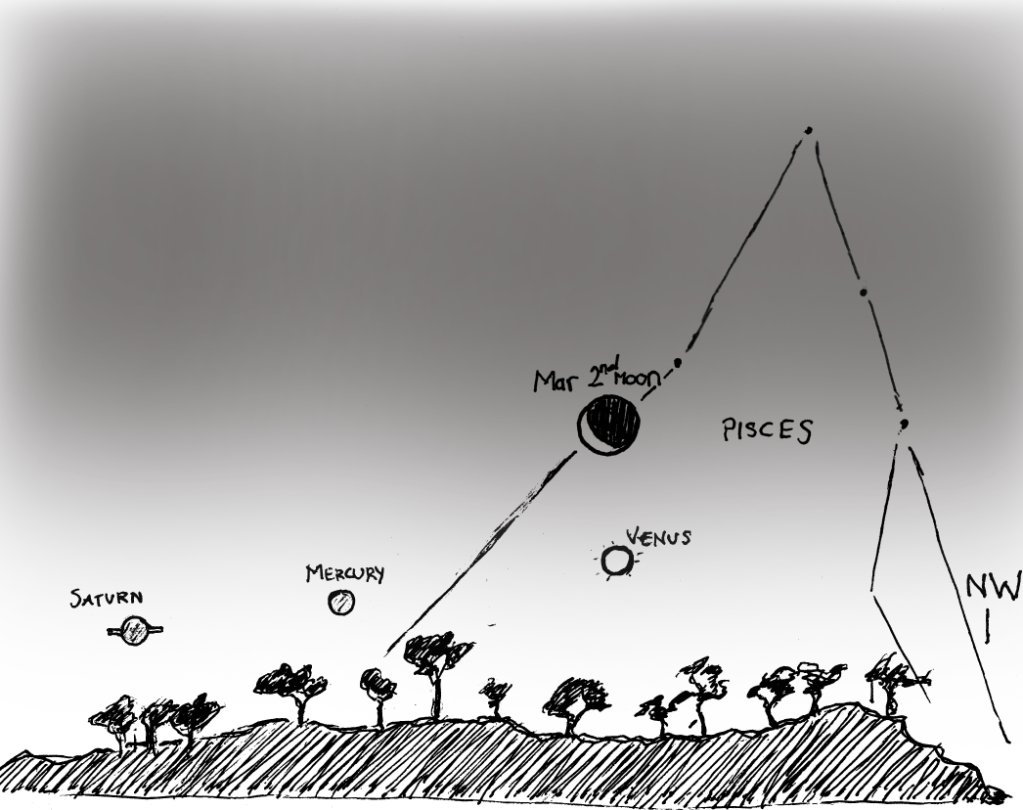
March starts with an array spectacular but difficult to view: Saturn, Mercury next to the merest sliver of New Moon, and Venus, all low on the western horizon just after sunset on the 1st – but only visible between about 7:15 and 7:40 pm, when they set. If you miss this, it’s worth looking the next two or three evenings at the same time – though the line will be broken.
March 14 will be eventful: the gamma-Normid meteor shower will be at its peak at this time, with up to six bright yellow, white or orange meteors falling per hour from the Norma constellation in the southern night sky However these will be rather outshone, and outdone, by the Full Moon, which will rise (at 6:40 pm) in a partially eclipsed state in the twilight, and reach maximum umbral effect just above the horizon – after which it will slowly lapse into normal brightness.
On March 20 the Earth will be at its first equinox for 2025.
 The Coburg Meddler