Which way will workers decide to go when they are required to return to their desks, restaurants, salons, wavepools? Premier Daniel Andrews has already expressed concern about Victorians flocking to public transport and cars now that restrictions are easing and peoplea are starting to return to work. In order to encourage ways of travelling that are more in-line with safe physical distancing, we need to see more investment in safe walking and biking lanes.
In Coburg and Brunswick the debate around how to make Sydney Road more bike friendly has once again been enlivened by calls to reduce pressure on potentially unsafe or environmentally friendly transport options. In July 2019 VicRoads asked Sydney Road users in Coburg and Brunswick to weigh in on four potential designs for a permanent bike lane along the main road, but had neglected to share the results of the survey. On May 17 this year, the results were finally obtained through a successful Freedom of Information request. 52 per cent of the 7000 respondents supported ‘Option 3’ which would remove all of the parking along Sydney Road to facilitate an extended footpath and a protected bike lane. Trams and cars would share one lane at all times.
Moreland BUG committee member, James Conlan, says that the results of the poll are promising and show that residents of Coburg and Brunswick are largely supportive of making Sydney Road more bike friendly at the expense of on-road parking. Indeed, the Council have been pushing for separated bike paths on Sydney Rd for a couple of years now, but the State government keeps getting in the way.
This year the Moreland Council has proposed allocating $3.13 million in their upcoming budget to ‘footpaths and bike paths’. James says that the Moreland BUG will be making a submission to double the bike budget and to separate it from the walking footpaths budget. The BUG have been seeking input from locals to suggest what bike-related improvements they would like to see.
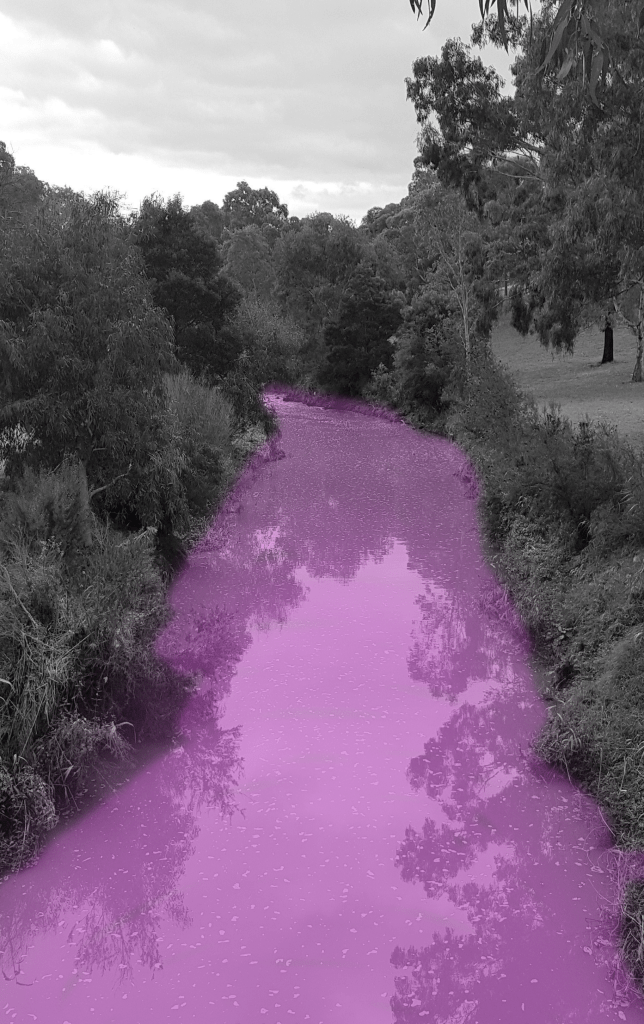
On the 5th of May locals in North Coburg were alarmed to find Edgars Creek running bright pink, with some reports of a pungent chemical smell. Melbourne Water and EPA Victoria were called in immediately to contain and investigate the pollution. Attending the scene on the 6th and again on the 9th, officers placed ‘boom’ containment devices around the area most heavily polluted. The booms were intended to remain for a few days, however heavy rains rapidly flushed out the creek and the colour returned to normal shortly thereafter.
EPA Victoria has since released a statement to assure locals the pollutant discovered was a dye, most likely used for clothing and non-toxic at the levels present in the water. It was unclear from their statements however, if these measurements reflected the water pollution levels before or after the rain, and at all points in the creek. The Meddler contacted Melbourne Water to obtain a full water quality report but at the time of printing have not yet received the documentation. When contacted by the Meddler, EPA Victoria were also unable to provide any further comment given the potential for future litigation, but have confirmed that through drain chasing processes, the business responsible for the spill have been identified and contacted.
For some locals this statement of assurance was not sufficient, with many online calling for a stronger response from EPA Victoria. Another strikingly similar incident occurred in the nearby Stony Creek back in September 2019 when a large bottle of red dye was blown over and spilled into the water system. In this case, the business responsible was identified to the public as Marchem Australasia – a chemical importer and distributor. As such, some are pushing for EPA Victoria to release more information regarding the recent Edgars Creek incident, but it looks like at least for now, they’ll need to wait.
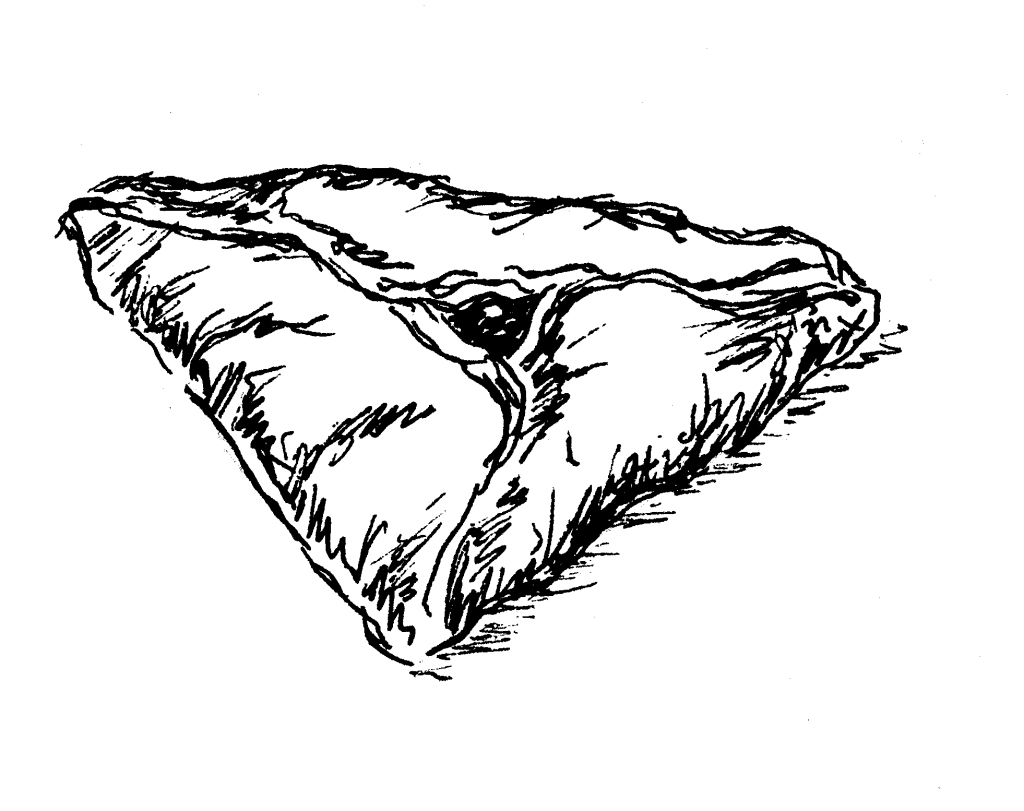
With the risk of cholesterol-induced injury, this reviewer took the opportunity to survey the baked goods of the Coburg area, with focus (if partly for my health) on spinach and cheese pies. First, the ultimate: Tabet’s Bakery, with its two locations on Sydney road, offers a perfect pide ($4-$4.50) in spartan surrounds, and remains a perennial favourite. Its menu is effortlessly consistent, serving Lebanese freshly baked goods every day for years whilst remaining always welcoming and radically affordable. From its pides, to zaatar, pizza and kaak, Tabet’s offerings are always of a high standard and have been so for decades. Ask for extra lemon juice and, if you are so inclined, also accompany your purchase with a bottle of ayran ($2.50), a yoghurt drink that is mysteriously unlabelled yet always recognisable by its milky colour and tart refreshing flavour. The kaak with haloumi ($5) – in a way the quintessential Lebanese toastie – is also a delight. As a minor quibble, the Coburg location unfortunately has an EFTPOS minimum which is an obstacle to the quick bite on the run, and should be amended given the current restrictions, especially as the Brunswick site has no such issue.
A1 bakery, the famous rival to Tabet’s, heralds its location on Sydney road, just south of Albion Street. When the coronavirus restrictions are fully lifted, A1 offers a big dining area and street-eating that does not have a rival. The A1 bakery spinach and cheese pie is missing the haloumi-hit of its neighbour, but does have many fans, plus the opportunity for a strong coffee, and a later browse of their shelves which host many middle eastern favourites. Unlike the other places mentioned, A1 often has a ‘buzz’ which is definitely felt on weekends.
Highly commended is the spinach and cheese pie of the austere Telstar Bakery, just south of Moreland Rd, in Brunswick East. Its large tiled eating area is coupled with the door that clangs shut – we wonder if the staff at Telstar are bothered by it, or in some ways hearing impaired – but that does not stop them from providing delightful baked goods. The pizzas are also very popular with locals, especially for the price ($6) and this reviewer guesses from the regular clientele that these pizzas might be the staple food for many who live nearby.
Also of note is Al Alamy, a veritable minimarket of middle-eastern delights. Its spinach and cheese pide is shaded by the exhaustive range of options available, from Turkish fairy floss, specially imported soft drinks, a range of halva and more. Al Alamy’s saaj ($2.50 – $6) is thoroughly recommended. Although best for its café feel and not its spinach and cheese pide, Zaatar, located on the corner of Munro St and Sydney Road, is well-presented, comfortable and offers a large range of dishes at a consistent quality. Zaatar also donates a significant sum to The Royal Children’s Hospital Appeal, so gets extra marks for its community engagement and effort.
Tabet’s Bakery 395 Sydney Rd, Coburg and 607 Sydney Rd, Brunswick Testar Bakery 84-90 Holmes St, Brunswick Al Alamy 51 Waterfield St, Coburg Zaatar 365 Sydney Rd, Coburg
In an attempt to be more virtually social, the Meddler reached out to what must be Coburg’s sibling community: Coburg (a town in Bavaria, Germany), to find out how the locals are feeling about their isolation. The following is an interview with proud Coburgian, Martin.
Please describe your city. A small town where people all know each other, went to school together, or belong to the same sports club. The city is proud of its history, the Duchy (Saxony, Coburg and Gotha) and the connection to the English royal family. Coburg has all the things that would be considered advantageous in a big city (theatres, restaurants, sports facilities and international festivals – e.g. samba)
In the past few months, how has Coburg changed? We have a new Lord Mayor who is just over 30 years old and full of energy. He gets a lot of planning and building done. The large companies (Brose, Kaeser or HUK) contribute millions in donations.
What are the quarantine / self-isolation restrictions in your city? Are these strongly enforced? All the conditions imposed in Bavaria as a whole apply in Coburg, and the Coburgers stick to them.
Do you think your government acted appropriately in this pandemic? Definitely. Of course you can always question and discuss one thing or another. All in all, the responsible parties are doing a good job. It is a difficult situation and “There is no glory in prevention”.
How did the people of Coburg react to this crisis? What is the general mood? Just like everywhere else in Germany – Coburg is no different from the rest of the country when it comes to this situation.
What have you discovered personally recently? Not much has changed for me during the crisis. Our company is surviving well through the crisis and is fully operational. It has launched a number of special items that are in great demand.
Do you have anything else you would like to share with our readers? Yes – the golf courses opened again on May 11th… Finally.
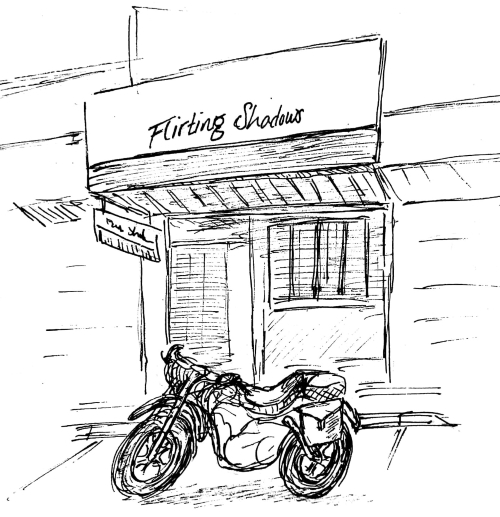
Lucky owns Flirting Shadows, a small cafe next to Victoria Mall. On top of this, he runs a consulting business in Dubai training staff on ‘aussie style’ cakes. He’s also worked more jobs than you can poke a stick at; he’s been a make up artist, oil and gas worker and has even been in the business of tailor made suits and public transport interior trimmings. He took some time out of his busy day to answer some questions while he made us a sucuk toastie.
Why the name Flirting Shadows? Before ‘coffee art’ was well-known, I called the designs you can make in coffee cups ‘shadows’. So, when I took over the lease from the Lebanese bakery that was here two and a half years ago, I decided to call it ‘Flirting Shadows’.
What made you start the business? I lived in Coburg for 4 years before buying the business. While living here I thought something was missing. Everywhere is a different spot. You can walk 50 metres one way and there’s a different crowd, then another 50 metres and it’s different again. For example, seniors here have regular hangouts, but that’s more in the mall. So, my place has different customers looking for what I offer.
What do you think about the new railway changes? The new works happening at the station are meant to make the place busier. They’re hoping to make the area nicer, but I know what happens under bridges.
What do you think about not paying rent during the pandemic? If I can’t pay rent I’ll just pack up and hand the keys back. I don’t know the owner’s situation, they might need my rent. But also rent is clearly too expensive in Australia – I’ve lived all around the world. And it doesn’t suit everyone to share a house, or share a room.
How is business during covid? The customers have been very supportive. If you go to buy bread, you get a coffee as well, even if you don’t need it — and that’s to support local businesses. A lot of people are also ordering online for pickup.
What are your future plans? I originally wanted to have a take away shop, because of being next to a carpark, but people want to sit. People want to feel secure which is difficult without bollards. The motorbikes outside the shop act as a type of bollard for the meantime. But hopefully I’ll get some proper seating soon. Apart from that, I like to keep my options open. I like working here for the moment though. I see it as by making you coffee I’m part of your day, and it contributes to how well your day goes.
Like it was the beginning of a school holiday, a lot of us began a global pandemic lockdown by writing ourselves a list of things we wanted to achieve. We wanted to be “productive” and have something to show for our time once we returned to society. The image of ourselves coming out of our time in the social wilderness a better person – armed with loaves of sourdough, a finished novel, and a more concrete sense of self – was intoxicating.
Six weeks on and with restrictions easing, many of us now face our unchecked lists and the prospect of returning to society with nothing to show for it. If we can’t create a masterpiece in isolation how are we meant to do it when life goes back to normal? Ignoring the fact that for many the lockdown has actually reflected greater economic instability, less time alone (with children, partners, and housemates never leaving the house), and the psychological toll of the constant threat of a highly contagious illness – have even the single-with-no-dependents among us really had the Walden-like experience of being isolated?
I too created a mental list of things I wanted to accomplish but then a confluence of things happened to me during the lockdown which have changed my perspective substantially. The first is that my phone fell in the toilet. This hadn’t happened to me before so I didn’t know the protocol. For future reference, never try to turn it back on until you’ve put it in rice for a few days. For about a week I was reluctant to buy a new phone, and like anyone who has been on a meditation retreat, I became acutely aware of my phone’s strangle hold on my attention, and annoyingly preachy about how much better I felt without it. At the same time, I was given the book How to Do Nothing: Resisting the Attention Economy by Jenny Odell.
In the book, Odell describes the myriad of ways in which technology has been intentionally designed to keep us scrolling and clearing push notifications as we face an onslaught of information, opinions, and advertising. At the same time, we face an increasing pressure to account for how we ‘spend’ our time – as if it is a currency which can only be validly used to purchase units of productivity or becomes wasted by doing “nothing”. While this thought is not particularly revelatory, Odell positions this addictive technology design in the broader context of the capitalist, workaholic, start-up culture that spawned it, and the political, communal, and environmental world that it is working to replace. She suggests that the combination of technology and this productivity fetish are not only hijacking our attention to sell us things, but also rendering us incapable, or at least, handicapped at holding our attention on anything that requires longer, sustained, more nuanced understanding – like the complex ecologies we live in, socially, politically, and environmentally speaking.
Instead, she says, we are training ourselves (on behalf of corporations) to respond more and more with reactivity instead of sensitivity; to view the world in terms of I:it (subject:object) relationships over I:thou (subject:subject). Facing a constant barrage of information and only equipped to understand things that can be quantified in terms of their immediate monetary and social capital, we are losing not only the attention span to plan, organise, and coordinate personal, political, or community projects, but the private unrecorded (for eternity) spaces to do so.
So, can it be any wonder that while we sit in our houses experiencing a constant white-noise of information – coronavirus updates, politicians issuing restrictions on what is valid or essential behaviour in between economic forecasts, advertisements boasting fashionable face masks and contact-free delivery and so on – that we didn’t feel the creative space and freedom to try something new and risk failure? Especially things as difficult to measure in value as creativity or personal growth?
Now that we are allowed to leave our houses for “non-essential” reasons, I would argue we are presented with more of an opportunity for changing our behaviour than before. I’m not saying we should all leave our phones in the back pockets of our jeans and forget about them until we hear them diving headfirst into the bowl. After a week of missing calls and inadvertently turning my husband into my personal assistant, I realised I needed a phone, caved and bought one. Odell doesn’t argue for this either – the benefits of being connected when we want to and need to be cannot be diminished. Instead, she proposes we merely practice exercises in attention so that we are better equipped to make that decision for ourselves.
So Coburgians, take a non-essential walk and look around you. You don’t need to do anything but try to notice all of the animals, plants, and spaces that normally form the backdrop of the world outside of its utility to you. This might be easier to imagine now that you’ve been away and the space has been well and truly their domain without any need for you. Do this so in turn when you look at yourself you might be able see yourself beyond your own utility, and so that when inevitably someone asks you what you got up to in lockdown, you can say defiantly say “nothing”.
Looking at the Last Quarter Moon during the early morning hours of June 13, it can be seen passing within a few degrees of the red planet Mars. (Another planet, Neptune, is also there, but invisible without binoculars). On June 19, just before sunrise, low in the east the almost-New Moon will be next to brilliant Venus, in the vicinity of the distinctive ‘V’ pattern of stars which includes the conspicuous star Aldebaran. Western astronomers know this as part of the constellation Taurus the Bull.
The Boorong people of north-west Victoria were reputed to be keen and renowned astronomers. Tragically they and their culture were displaced, dispersed or destroyed as their lands were taken, and we have only second hand accounts of their knowledge. It is believed they saw Aldebaran as part of the constellation of Gellarlec the Songman, who keeps the essential knowledge of the people. Gellarlec’s name may be derived from that of the pink cockatoo, also a songster, and whose salmon colouring corresponds to that of Aldebaran’s.
Just west of Melbourne, the Wathaurong people have left physical traces of their astronomy, at Wurdi Youang. This is an arrangement of about a hundred large basalt stones in a shape somewhat like the silhouette of an ice-cream in a cone. The two straight sides of the cone point directly to the midsummer and midwinter sunsets, with the line of symmetry between them pointing directly East-West. Sadly much knowledge of this construction was suppressed by missionaries and lost.
Midwinter Solstice occurs this year on June 21. It may be of interest to learn that, whereas the Winter Solstice is the day with the least hours of daylight, it is usually not the day with the latest sunrise and earliest sunset. Due to the elliptical orbit of the Earth, these may occur a few days either side of the Solstice.
The opposition of Earth and Jupiter, when the two planets are at their closest, occurs on July 14, and the opposition of Earth and Saturn, on July 21. With more than a year until the next oppositions and the two planets’ proximity in the early night sky (in the east from dusk onwards), mid-July is the perfect time to view these magnificent gas giants. If you have access to a telescope there is a wealth of viewing objects: Jupiter’s four moons, its weather (particularly the Great Red Spot, the largest known cyclone in the Solar System), Saturn’s eight moons, and, of course, the Rings. (If you are looking at any of these moons, there are charts available so that you can identify them.) Even for the unaided eye, Jupiter is brighter than any of the stars in the night sky – but it will be upstaged on the evening of July 5, when the Full Moon, Saturn, and Jupiter will make an outstanding line-up.
An easy-to-understand explanation of specific law-related issues. DISCLAIMER: This information does not constitute legal advice; don’t get your legal advice from a newspaper, only get legal advice from a practising lawyer!
For workers and those unemployed (happily or unhappily), take note: employment rights have temporarily changed in Australia! The new provisions began on 9 April and they are expected to end on 28 September.
Before the new changes to the law were introduced, you could generally reject proposed changes to your contract on the basis that new changes needed the consent of both employee and employer. Under the new laws, you’re not allowed to unreasonably refuse reasonable requests (referred to in the legislation as ‘directions’) by employers. So, if your employer directs you to work extra hours, for example, you will need to consider whether the extra hours are reasonable. What qualifies as ‘reasonable’ is one of those murky legal questions that has no definitive answer; it depends. Lawyers at JobWatch, a community legal centre that specialises in employment law, recommend that you consider your own situation with regards to your health and safety, your personal circumstances, the usual nature of your work, monetary compensation and whether you were given enough notice about the changed conditions.
Crucially, any new arrangements made between you and your employer will not apply unless you were first consulted and given written notice of the employer’s intention to make a new direction at least 3 days before the direction is given (or you genuinely agreed to waive the notice period).
TIP! Make sure any new direction that you agree to is explicitly temporary; you don’t want to suddenly be stuck with arrangements made under a pandemic when things return back to normal!
Before the changes, an employer could stand down a worker during a period in which the worker cannot be usefully employed due to, for example, industrial action, a breakdown of machinery or other stoppage of work. If a worker has been lawfully stood down, then the employer is not required to pay the worker for the period of time that work is stopped. At a recent panel event, lawyers from JobWatch noted that before the changes were implemented on 9 April, the cause of the work stoppage must have been out of the employer’s control. This means that the employer would not be empowered to stand down their workers simply because it had become uneconomical, and it might constitute unfair dismissal if they did so. This is because the decision to stop work would be a decision made by management, and not the pandemic directly. If you were stood down before 9 April, make sure you seek free legal advice about whether this was lawfully done.
The temporary changes to the law now allow the employer to, between 9 April and 28 September, stand down an employee due to changes to business that are attributable to the pandemic or a government initiative to slow the virus, however they can only stand you down if you are eligible for the jobkeeper payments. This means that if you get stood down during this period, you should be receiving the jobkeeper payments of $1,500 per fortnight.
If you’re not sure whether your employer has done the right thing, or if you want some help understanding your rights you should call JobWatch ((03) 9662 1933) or the Fair Work Commission (1300 799 675). If you are under 30 you can also contact the Young Workers Centre (1800 714 754).
A friend sent our group chat a photo of me walking my dog on an emptystreet last week. I was bothered because he didn’t say hello, and also I felt weird that my photo was taken without me knowing. I know it was meant to be funny, but I’m feeling bothered by it. Am I overreacting?
Taking and sharing photos without consent is something some (mostly younger) people do as a “joke”. Smartphones and apps like Snapchat have desensitised young people to having their picture taken and shared to the point where consent is often taken for granted. Your friend probably didn’t give this much thought, but that doesn’t mean you’re overreacting. There are many reasons why you might feel uncomfortable or creeped out about having a photo taken without your knowledge: e.g. experiences of stalking, street harassment or bullying.
Maybe you just feel uncomfortable being watched without your knowledge – that’s valid too. You have a right to ask that your friends don’t take photos without your consent, no matter your reason. I think it’s also reasonable to feel bothered that your friend didn’t say hello. In this period of lockdown and social isolation many of us are feeling loneliness and looking for connection. It might be different if your friend was rushing off somewhere and didn’t have time to stop, or even if he wasn’t in the mood to get into a conversation that day. But he stopped and took a photo, which suggests he had the time and headspace to engage with you but chose not to.
I would broach the subject with your friend gently – acknowledging that he probably didn’t mean anything by it, but sharing how it made you feel and why you ask that it not happen again.
Back in New Zealand we hold a ceremony for my niece.
The kowhai tree was already planted – nevermind.
Oh, and her placenta was kept in an old ice cream container – but, nevermind.
She was grizzly, and I searched up a poem on the internet, tidied up the Google Translation from the Māori, mistranslated a few bits on purpose, tucking the gendered language out of sight (no respect) – nevermind.
My brother didn’t dig the hole, my sister-in-law wore her old Florence and the Machine t-shirt.
Lungs.
The waves crash over the road.
Next week, the air will be thick with smoke. Next year, the very air will burn. Next decade
-nevermind.
Hine-te-iwaiwa hangs above us, her belly round, her basket overflowing, her hands deftly weaving threads
that are not ours.
We borrow her, this goddess. We borrow my niece. We borrow the whenua. And we give it back, softened, crumpled.

 The Coburg Meddler