
“Dangerous Merri lurker” / Ally
By Dr Emma Boehm
Floating floating Brownian motion
Flowing where the current takes me
Bubbles thrashing now I’m airborne
Oh! I’ve found some warm environs
Air sugar heat and protein
Perfect timing best conditions
Now my job is multiplying
Chewing through these tender tissues
Help my patient’s not responding
To the only drugs I’ve got
Overusing antibiotics
Have put us in an awful spot
Floating floating Brownian motion
Flowing where the current takes me
Oops I’m stuck on to the surface
Hold on while I push inside
Copy copy copy COPY
I have made a lot of me
Can we find more copy homes?
This one’s busted let’s spread free
Listening to Mother Nature
Gives us clues on how to fight
Microscopic hungry varmints
Problems of our own devise
This is inspired by the scientific paper “Genetic variation in individuals from a population of the minimalist bacteriophage Merri-merri-uth nyilam marra-natj driving evolution of the virus” published by Monash University researchers Thung et al. in the journal mBio (Volume 15, Issue 12).
In this work the authors study Merri-merri-uth nyilam marra-natj (MMNM) which is a virus that they found in the Merri Creek. It was named by Aunty Gail Smith of the Wurundjeri Woi wurung people, meaning “Dangerous Merri Lurker”. MMNM is a bacteriophage, meaning a virus that instead of infecting humans (like a flu or COVID19) infects bacteria (cells much bigger than viruses but still microscopic compared to humans and cause diseases like pneumonia).
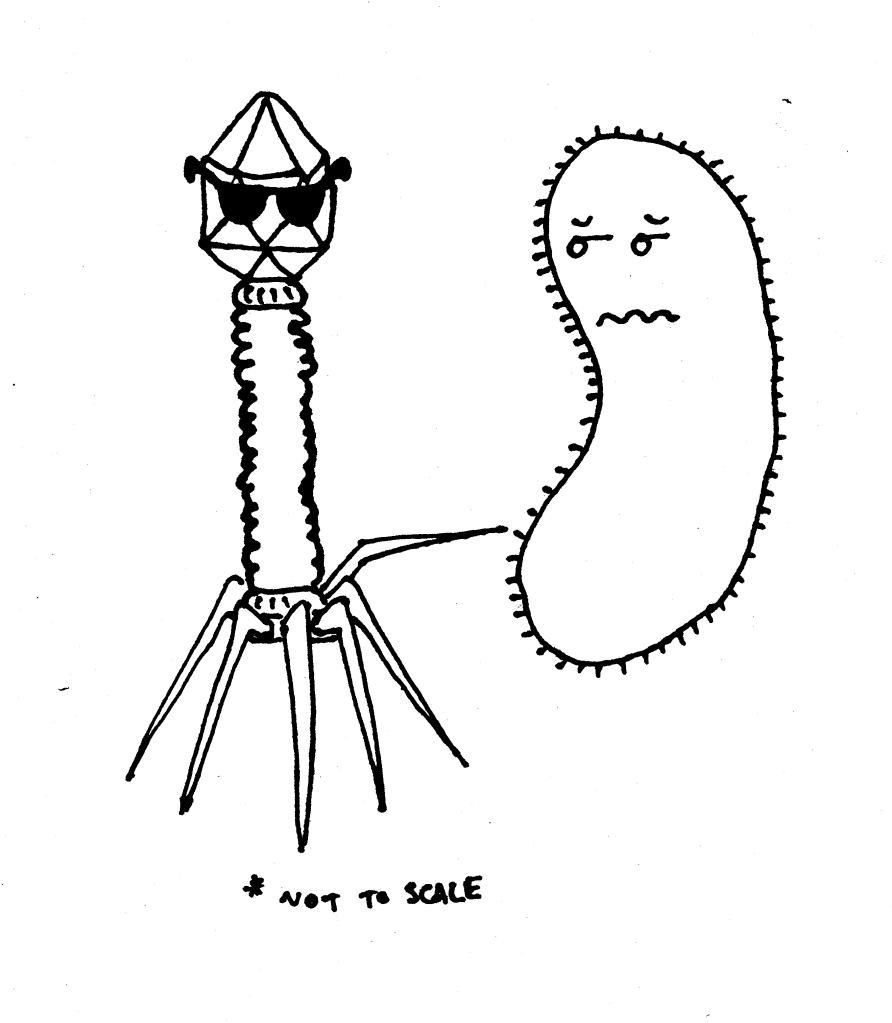
This poem first describes a person being infected by a bacteria and getting pneumonia, and then MMNM infecting a bacteria. Bacteriophages like MMNM float in water, moving randomly (Brownian motion) until they make contact with a bacteria (their host). Then they bury inside the bacteria and use the bacteria’s inner machinery to makes copies of themselves until the bacteria breaks open, releasing the MMNM copies to find more bacterial hosts.
Worldwide, bacteria are becoming more resistant to antibiotics (like penicillin) for lots of reasons that include inappropriate use of antibiotics in medical practice, and the use of antibiotics to prevent and treat infections in animals used for food production. In the future, bacteriophages like MMNM might be a new strategy against these antibiotic resistant “superbugs” if researchers can figure out how to safely harness their bacteria-killing powers.
 The Coburg Meddler