
The following article is drawn from a document that Gary Vines produced after learning of Council’s plan to replace the Harding Street Bridge with a large, flat, truss style bridge with 3m high walls.
The proposed bridge has had very little opportunity for locals to access input (save for a survey on the colour and width of the bridge on the Council’s website). However, there has been a long and concerted effort by local residents and environmental groups to repair the damage of 150 years of neglect and abuse of the creek valley. Much of the native vegetation and attractive character of the creek is the result of local people working together. Social history of this crossing and the former bridge should be considered.
Additionally, with any major project along the creek, potential discovery of Aboriginal artefacts should be considered- such as was the case during the creation of the DeChene Reserve bridge. Therefore, an Aboriginal Cultural Heritage Management Plan should be undertaken, even if it is not mandatory under the regulations. Consideration should also be given to an assessment of potential historical archaeology on the site.
Ultimately, the combination of through truss and handrail that is being proposed is a tidy engineering solution, but it limits the aesthetic opportunities. Cable-stayed and suspension bridges are intrinsically more attractive, as evidenced by the recently completed bridge just north of Ceres.
It is important to note that the most environmentally sustainable option would be to retain and reuse the existing structure as much as possible. Timber is a renewable resource, and while it needs periodic replacement, the replaced members can themselves be recycled to other uses.
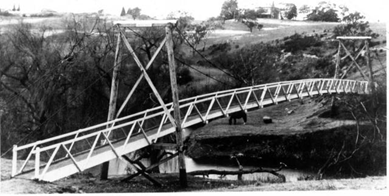
The existing bridge suspension towers are more than 2.5 metres between members, so the required width can be achieved by reconstructing the deck and handrails reusing the existing suspension cables. If necessary, new timber (or steel) trussed side rails, deck and cables could be employed if the existing materials are deemed unusable. By suspending a new wider truss railing outside these, even greater width can be achieved with just a small pinch point at each end. Reusing the original towers would also mean that no vegetation would need to be removed and Melbourne Water would not have issues with any new structures in the floodway. It might be necessary to upgrade the cables and reinforce the towers, but the existing structure could be employed as a platform for threading new
cables, reducing construction costs.
Even if the reuse option is not followed, the proposed through-truss is a very poor design. It creates far more of a visual barrier both as an intrusive element in the otherwise natural appearance of the creek corridor, and for people using the structure. A better option might be to use a deck truss design, since there is no particular need to maximise clearance under the bridge. This would of course require a separate handrail, but most of the engineered structure would be below the bridge and so a lighter railing and safety fence could be used.
The most important aspect of the proposed reuse and reconstruction option is that it recognises the value of the local community in the restoration of the Merri Creek, through the hard work of thousands of people over many decades as well as ensuring the continued enjoyment of the creek by all users.
By Gary Vines
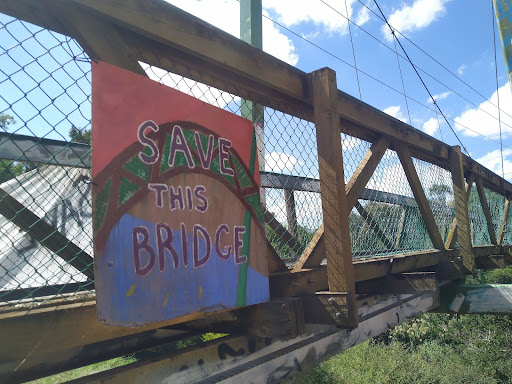
A campaign to ‘Save the Harding Street Bridge’ has been created by locals interested in keeping the current bridge.
The campaigners assert that more bridges are useful and that taking the Harding St Bridge down is unnecessary, and are asking for a second, more accessible bridge to be built nearby.
Visit https://chng.it/LwSdkYwjQY to join in on the campaign.
 The Coburg Meddler