
April 23rd is a noteworthy date for meteor-spotters: two different meteor showers will be at their peak. The Lyrids will be seen low in the northern sky in the constellation Lyra, near the brilliant star Vega, with peak rates of meteors occurring in the morning hours of the 22nd and 23rd. The pi-Puppids originate in the southern constellation Puppis, south of the brightest star, Sirius, and peak time will be in the pre-midnight hours of the 23rd. While each of these showers can be spectacular at their peak, this may only last for an hour or so. Furthermore, the gibbous Moon will provide an unwelcome source of light distraction until moonset (00:39 am on the 22nd,1:47 on the 23rd).
On April 27th Mars will join M35, a cluster of hundreds of stars, which, under good viewing conditions, can be seen to be a group with the unaided eye. Look in the north-west sky after sunset. Then turn to the east, to view the full Moon rising as a supermoon.
May 7th brings a chance to see the peak of yet another meteor shower, the eta-Aquarids in Aquarius. These are the debris from Halley’s Comet, and promise to be spectacular and prolific: fast, bright yellow, and with up to sixty per hour. Best viewing time will be just before dawn, say 5:30 am, when Aquarius will be overhead.
In the traditions of the Australian Aboriginal people, meteors are often associated with serpents, evil magic, omens of death, and punishment for breaking laws. In Torres Strait, the Meriam Mir people see meteors, called Maier, as the souls of the recently deceased, on their way to the Land of the Dead. When a person dies, their spirit is taken to the top of the tallest palm tree, which is set alight, and the spirit is launched on its way. The resulting Maier’s trajectory and brightness suggests where the dead person came from, and how important they were.
A striking line-up in the sky may be seen, briefly, in the twilight of May 13th, as Venus, a very new Moon, and Mercury line up in the northwest, just below the V-shaped Hyades. Look to the horizon between 5:30 pm and 6, when they set. This tableau is easily missed, but will be repeated over the next few nights, with the Moon gaining in height and phase. On May 15th the Moon will be next to the M35 cluster mentioned above, and on the 16th, it will be next to red Mars in Gemini, with the twin stars Castor and Pollux nearby.
At this time, Venus will be heading away from the Sun and remaining longer in the evening sky, but Mercury will be heading back towards the Sun, and at 6pm in the May 29th twilight, the two planets will pass each other, separated by less than 1°.
The yellowish gas giant Saturn, with orange Jupiter below, may be seen during May after midnight, in Aquarius in the eastern night sky. On May 30th, the Moon, slightly past full, will draw near Saturn, and two nights later, will be next to Jupiter.
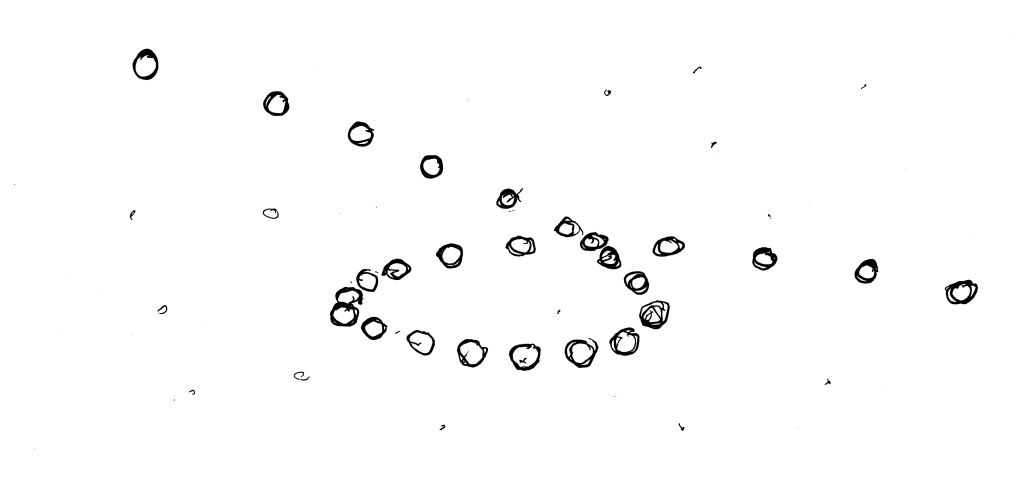
The outer planets move a little each night against the backdrop of stars, usually shifting from west to east. On May 24th, Saturn will stop moving- and on the following nights its path will be a u-turn, after which it will travel counter to the usual direction for a few months. Western astronomers explain this retrograde motion of the planets in terms of differing radial velocities. For Aboriginal people, the path that the Sun, Moon, and planets travelled along the zodiac was often regarded as a road for primary ancestor spirits. In the traditions of the Wardaman people of Northern Australia, Uncle Bill Yidumduma Harney, an elder, describes the planets with their retrograde motion as ancestral beings walking along this road, sometimes slowing down or stopping, and then coming back for another yarn with other ancestors, before moving on again.
By Vlack
 The Coburg Meddler