
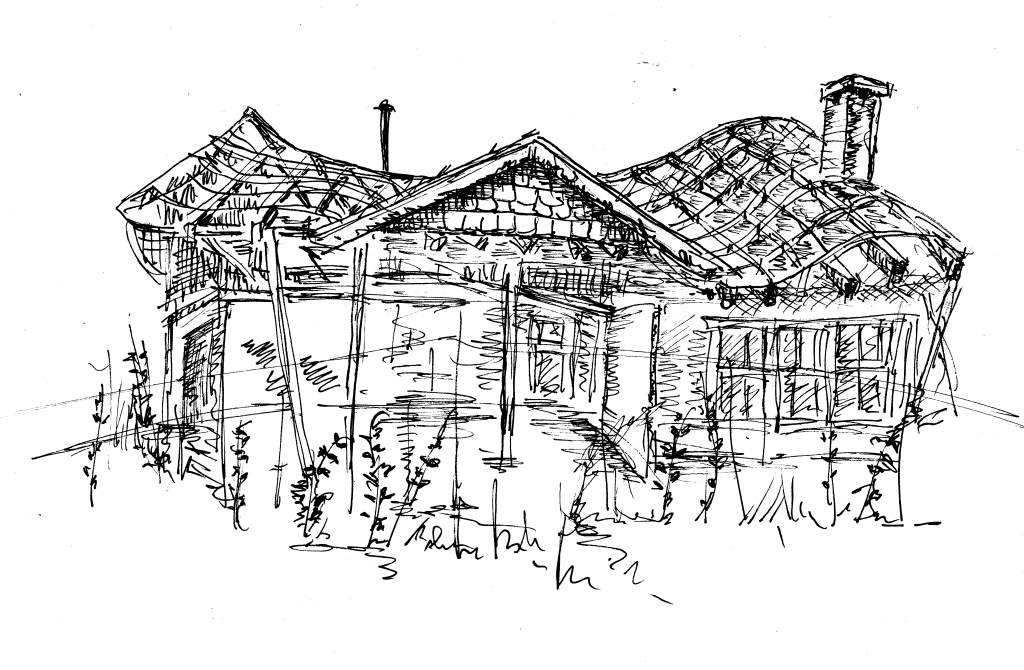
In January 2021, Moreland Council voted to refuse a planning application to demolish the dilapidated house at 65 The Grove, Coburg, and construct two, modern, double storey townhouses. The house has been left to rot over a period of 20 years.
The current owner of 18 years has ignored multiple council orders to bring the property up to scratch. During this time, an internal structural wall was removed at an unknown date causing serious structural damage, and in 2014, structural verandah piers were removed by an unknown culprit, causing the house’s roof to collapse. After this point, the property was put into a state of serious disrepair.
In their decision to refuse the demolition application, Councillors Conlan, Pulford, Panopoulos, Riley, Bolton and Davidson argued that the owner should not be rewarded with a planning permit for his wilful neglect of the property, refusing to reward ‘demolition by neglect’. The brave decision was reported in The Age and ABC Radio.
The question still remains: what should be done with a house that can’t be salvaged or legally demolished?
Before answering this question, it’s worth analysing how this situation occurred. Comparative to other countries, Australia’s state and federal planning and heritage laws are weak. They have frequently enabled developers to buy historic buildings in order to let those buildings fall apart and consequently be rewarded with a development permit that makes them millions in windfall profits.
The illegal demolition of the 160 year old Corkman Inn in Parkville highlights just how weak our planning and heritage laws are. The owners of the pub, with knowledge of the laws, chose to demolish the building in broad daylight, simply factoring the fines into the cost of doing business.
Can you imagine a 19th century terrace on the Champs-Élysées in Paris slowly decaying over a few years, falling down, then the owner being rewarded with a permit by the city government to build a skyscraper on the site? No. This would not happen because the city has strict laws prohibiting this behaviour, carrying severe financial and legal penalties. This scenario is commonplace in Australia because our planning and heritage laws are deliberately weak- a result of politicians receiving substantial donations from property developers.
But it doesn’t have to be this way. Victoria’s Minister for Planning could discourage illegal demolition by imposing jail terms for those who deliberately and illegally demolish heritage buildings. To deter ‘demolition by neglect’, owners of heritage properties whose buildings collapse (from either neglect or design), could be refused from redeveloping the site, which could alternatively be acquired by the state and handed back to the community for public use e.g. a park, community facility or other free, community use.
In the last few days it has come to light that the owner of 65 The Grove has appealed Moreland Council’s decision to VCAT just before the 60 day appeal window lapsed. But the owner has arguably forfeited his right to own the historic property by deliberately ignoring council orders to fix it up and allowing it to fall apart. Thus, the site should now be returned to the community and converted into a public park.
While the property is privately owned and the land is zoned residential, which prohibits use for the purpose of a park, this is where Moreland Council could step in.
Councils are actively involved in the rezoning of land. They frequently begin the process through Planning Scheme Amendments, which allow council to change the planning rules of certain areas of land. While Planning Scheme Amendments must ultimately be approved by the Victorian Planning Minister — and could easily be refused — commencing this process signals the Council’s intentions for how they want their land used and developed.
Moreland Council could start a Planning Scheme Amendment for 65 The Grove, which would involve applying a Public Acquisition Overlay (PAO) to the site. A PAO would transfer ownership of the land into the Council’s hands, removing the need for Council to purchase the private land from the owner.
As part of the Planning Scheme Amendment, council could also apply a Public Park and Recreation Zone to the site, which would allow the site to be converted to a public park. Council could begin the Planning Scheme Amendment process via a majority resolution at an Ordinary Council meeting, which would be followed by Council officers doing the administrative work to prepare the amendment, followed by a submission to the Victoiran Planning Minister.
This might be seen as a radical idea. But so is illegally destroying the physical and social fabric of communities. The proposed public park is a proportionate response that would benefit the Moreland community and hopefully send a signal to other cowboy developers to respect people, history and planet.
By F Commons
 The Coburg Meddler
5 replies on “WHAT NEXT FOR 65 THE GROVE?”
Good plan. The developers behavour is unconscionable and shouldn’t be rewarded.
LikeLike
House now demolished and site levelled.
LikeLike
Glad I found your articles on the recent, sad history of the property. After having seen it’s poor state on walks down The Grove back in 2016, I was very interested in what led to a house on such an architecturally significant street being left in such a state.
LikeLike
Yes the council has all the power when it needs in this case. But what about when the council refuses to act on a situation where their asset such as a storm water drain or pit are at fault. These assets if left unattended can cause home owners thousands of dollars damage and a lot of mental grief. Not to mention the inconvenience to the general public. Such as a property in Albion st Brunswick where the owners have been fighting the council for 18 months about a faulty storm water pit. This pit was installed within the angle of repose meaning it was installed too close to the foundations of a building without proper engineering. When this was first brought to their attention they denied repairing the footpath above the sunken area saying Yarra Valley Water did repairs there to misguide the owner. After applying for a Freedom of information it was proven the council did such works. The council has only now started an investigation into the cause of excessive ground water which has now damaged three houses. So can the council now be treated the same way as the owner of 65 The Grove ??
LikeLike
If a property owner can be dealt with in this way for letting a heritage building fall into disrepair, can the council be dealt with in the same way if they neglect to maintain their services that causes damage to a residential property which is also heritage listed ?
LikeLike