
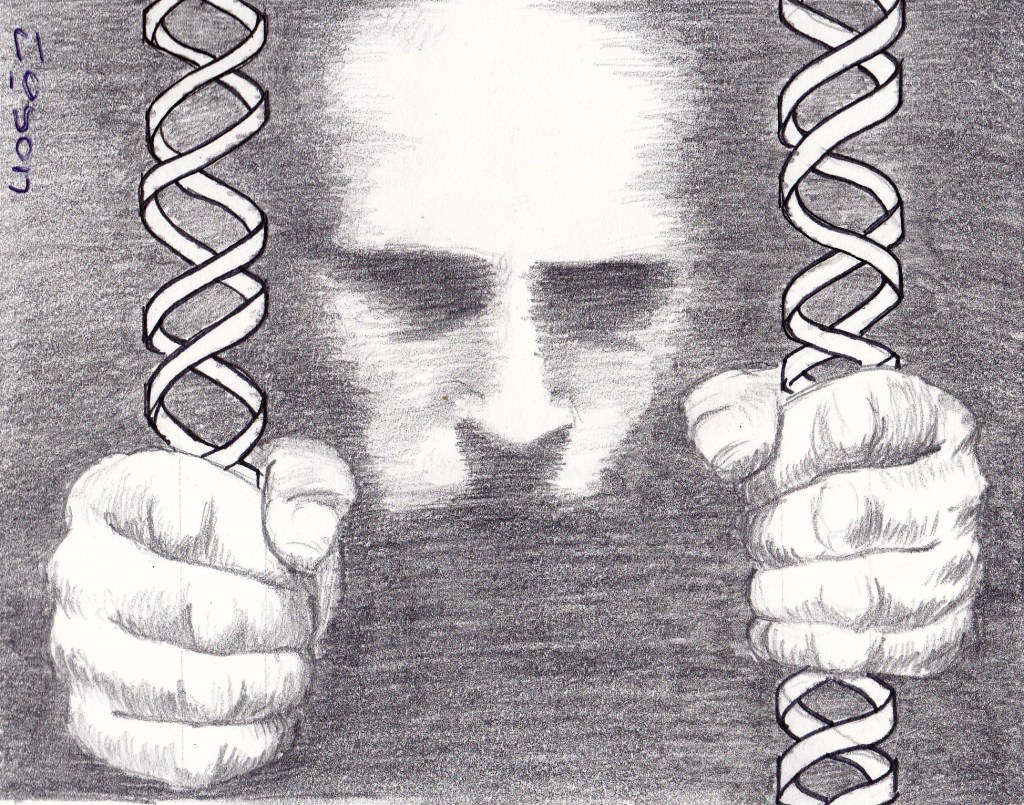
In 2066, a small group of haematologists testing a new imaging technique discovered an unfamiliar sight in a blood sample. It resembled DNA, yet didn’t conform to its conventions. To confirm it wasn’t an aberration with the donor of the sample, each scientist took a sample of their own blood and examined it – in each sample, they found the existence of the same strand.
The application of existing modelling techniques yielded little but a string of seemingly random letters and numbers. When the preliminary data and findings were published, scientists and the public alike saw it as an object of fascination, as we thought we had come to know everything there was about the human body. Answers were less forthcoming, however.
18 months later, an amateur cryptographer claimed to have decoded the letter-number string using a variant on a cypher used in Poland during World War II. She sent a decoded version of the original sample to the scientists, but the results turned out to be laughable. They were simply a list of what could loosely be described as ‘misdeeds’ – petty theft, lies, adultery, cowardice, violence, all with a timestamp and some descriptive information. For example: “08/10/2032 17:59:32 – Lied about whereabouts to wife Clara.”
This was widely written off as the work of a crackpot, but when the ‘results’ were jokingly published in the paper, the donor of the original blood sample contacted the scientists in a panic to explain that, in fact, everything on the list was something he’d done.
The theory then turned to it being a hoax, but there was certain information on the list that he was sure that nobody could know. Furthermore, each scientist began to receive their own decoded tests from the cryptographer. As with the first, it seemed to resemble a complete index of misdeeds, and, as with the first, they were all accurate.
In the following months, there was an explosion of interest and speculation. The blood imaging technology got rushed to market, and testing became widely available after the cryptographer made public her cypher. People flocked to get tested to see if it really worked, which it invariably did, though many were not prepared for the results.
Meanwhile, nobody could explain the new strand’s existence. Scientists were puzzled at the fact that it seems to have been designed to be read by humans. There were disputes over its veracity by scientists and those in the public sphere, but these quickly came to indicate guilt more than anything else. Religious figures speculated it was a message from God about the inescapability of judgement. Others decried it as devilry.
Since the discovery, we’ve initially seen a drop in crime, misdemeanours, and anything anti-social. Over time, though, people have begun to revert back to normal – small things at first, and now crime is returning. People lament that nothing has changed, but I disagree. Punishments have become lighter, sentences shorter, and personal rifts less severe – in the absence of doubt and denial, and because we now know that no person is not a sinner, all we can learn now is forgiveness.
By B Haughtly
 The Coburg Meddler