
Like it was the beginning of a school holiday, a lot of us began a global pandemic lockdown by writing ourselves a list of things we wanted to achieve. We wanted to be “productive” and have something to show for our time once we returned to society. The image of ourselves coming out of our time in the social wilderness a better person – armed with loaves of sourdough, a finished novel, and a more concrete sense of self – was intoxicating.
Six weeks on and with restrictions easing, many of us now face our unchecked lists and the prospect of returning to society with nothing to show for it. If we can’t create a masterpiece in isolation how are we meant to do it when life goes back to normal? Ignoring the fact that for many the lockdown has actually reflected greater economic instability, less time alone (with children, partners, and housemates never leaving the house), and the psychological toll of the constant threat of a highly contagious illness – have even the single-with-no-dependents among us really had the Walden-like experience of being isolated?
I too created a mental list of things I wanted to accomplish but then a confluence of things happened to me during the lockdown which have changed my perspective substantially. The first is that my phone fell in the toilet. This hadn’t happened to me before so I didn’t know the protocol. For future reference, never try to turn it back on until you’ve put it in rice for a few days. For about a week I was reluctant to buy a new phone, and like anyone who has been on a meditation retreat, I became acutely aware of my phone’s strangle hold on my attention, and annoyingly preachy about how much better I felt without it. At the same time, I was given the book How to Do Nothing: Resisting the Attention Economy by Jenny Odell.
In the book, Odell describes the myriad of ways in which technology has been intentionally designed to keep us scrolling and clearing push notifications as we face an onslaught of information, opinions, and advertising. At the same time, we face an increasing pressure to account for how we ‘spend’ our time – as if it is a currency which can only be validly used to purchase units of productivity or becomes wasted by doing “nothing”. While this thought is not particularly revelatory, Odell positions this addictive technology design in the broader context of the capitalist, workaholic, start-up culture that spawned it, and the political, communal, and environmental world that it is working to replace. She suggests that the combination of technology and this productivity fetish are not only hijacking our attention to sell us things, but also rendering us incapable, or at least, handicapped at holding our attention on anything that requires longer, sustained, more nuanced understanding – like the complex ecologies we live in, socially, politically, and environmentally speaking.
Instead, she says, we are training ourselves (on behalf of corporations) to respond more and more with reactivity instead of sensitivity; to view the world in terms of I:it (subject:object) relationships over I:thou (subject:subject). Facing a constant barrage of information and only equipped to understand things that can be quantified in terms of their immediate monetary and social capital, we are losing not only the attention span to plan, organise, and coordinate personal, political, or community projects, but the private unrecorded (for eternity) spaces to do so.
So, can it be any wonder that while we sit in our houses experiencing a constant white-noise of information – coronavirus updates, politicians issuing restrictions on what is valid or essential behaviour in between economic forecasts, advertisements boasting fashionable face masks and contact-free delivery and so on – that we didn’t feel the creative space and freedom to try something new and risk failure? Especially things as difficult to measure in value as creativity or personal growth?
Now that we are allowed to leave our houses for “non-essential” reasons, I would argue we are presented with more of an opportunity for changing our behaviour than before. I’m not saying we should all leave our phones in the back pockets of our jeans and forget about them until we hear them diving headfirst into the bowl. After a week of missing calls and inadvertently turning my husband into my personal assistant, I realised I needed a phone, caved and bought one. Odell doesn’t argue for this either – the benefits of being connected when we want to and need to be cannot be diminished. Instead, she proposes we merely practice exercises in attention so that we are better equipped to make that decision for ourselves.
So Coburgians, take a non-essential walk and look around you. You don’t need to do anything but try to notice all of the animals, plants, and spaces that normally form the backdrop of the world outside of its utility to you. This might be easier to imagine now that you’ve been away and the space has been well and truly their domain without any need for you. Do this so in turn when you look at yourself you might be able see yourself beyond your own utility, and so that when inevitably someone asks you what you got up to in lockdown, you can say defiantly say “nothing”.
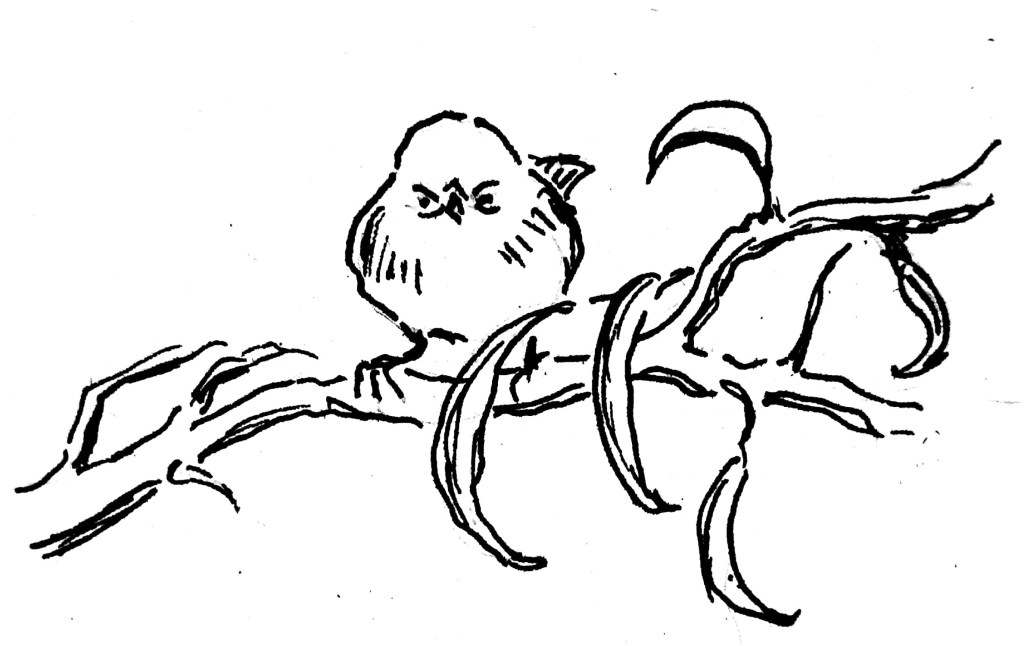
By Joyce Brinkley
 The Coburg Meddler