
By Vlack
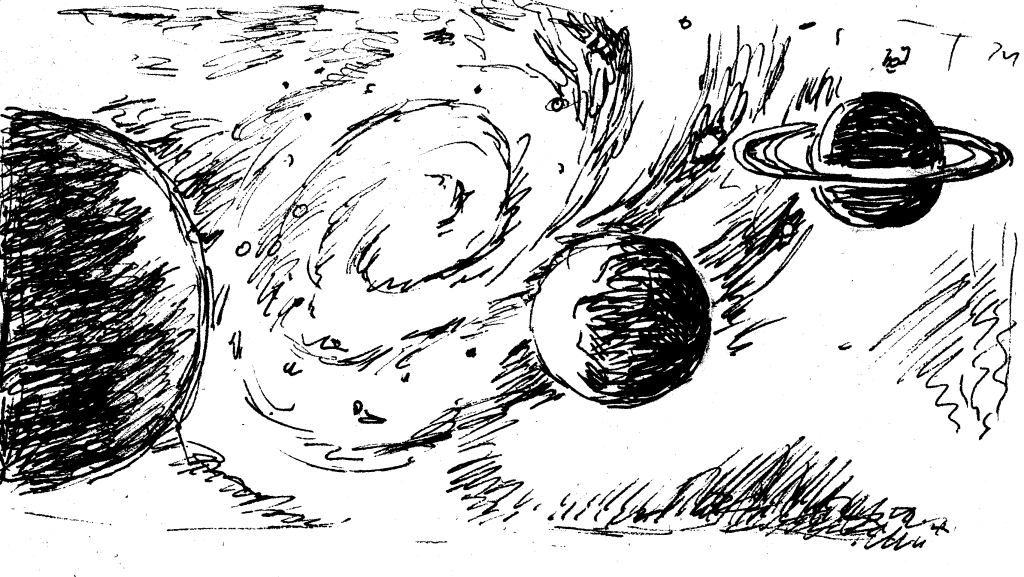
If you are outside at about 2 a.m. under a clear sky in April, face the east, and you will see a striking trio of planets lined up above: reddish-orange Mars, yellowish Saturn, and the highest and brightest, Jupiter. Mars is relatively close to Earth now, and with binoculars, you may see it as a disc, not just a red dot; and you may also see the rings of Saturn and the moons of Jupiter. Between the 15th & 17th of April,the Moon, in its Last Quarter phase, will be passing near these three planets.
If you’re watching later on in the morning, say around 6 a.m., you can see another planet added to the view: Mercury, which rises about 5 a.m. in mid
April. For the planet-watcher, Mercury can be elusive, usually hidden by -or outshone by- the Sun. But now, for a few weeks, we have the best views of it until much later in the year. On April 22nd the Moon will be very close to Mercury- although with the Moon almost New, and only just above the horizon at dawn, it may be hard to spot this.
The evening sky also has its attractions. Venus will be prominent, low in the western sky in April twilights, and on the 3rd and 4th of April, the constellation of Pleiades, or the Seven Sisters, will appear to become an octet as Venus passes through. Look for this immediately after sunset. Venus is so bright that it can be seen in daylight – although this is difficult if you don’t know where to look.
Speaking of the daytime skies, don’t look at the Sun! (even with sunglasses) – but we must mention that it is currently going through a major upheaval as its South and North Magnetic Poles change places. This sounds alarming, but happens regularly about every 11 years, and is part of a cycle related to sunspot activity. This solar magnetic activity has been observed through 24 such cycles, but the mechanics of it are still poorly understood. However, as it affects the Earth’s ‘space weather’, radio transmissions, the amount of UV radiation reaching the Earth and possibly terrestrial weather and climate, it is a vital area of study. The Parker Solar Probe, orbiting well within Mercury’s orbit, will continue to gather information on this subject over several years.
In Australia, the autumn equinox is on March 20. Not only are day and night of equal length, but the equinoxes are the only days when the Sun rises exactly in the east and sets exactly in the west. For the other days of the year, this cannot be said to be strictly true.
(Note: stated times are in Australian Eastern Standard Time, not Australian Eastern Daylight Time – add an hour for daylight saving, i.e., up to 5th of April)
 The Coburg Meddler